What Happens During a Professional Brake Pad Replacement?

On each trip, the braking system plays an important role in ensuring that the car is safe and controllable. As time passes, the distance to brake increases while the efficiency of braking reduces because of wear and tear of the brake pads through continuous usage without replacing them in the right manner. Brake pad replacement entails much more than simply replacing the pads. It involves a comprehensive examination of various components of the braking system to ensure that the braking system functions safely and reliably.
Each of these steps is crucial for maintaining the optimal performance of braking systems and for ensuring that the various components they include last a long time. This is a reason why it is important that the replacement process goes through the different stages and is carried out by professionals who keep the braking system optimal and guarantee that all the components will last for a long time.
Initial Brake Inspection
All professional replacements start by inspecting the brake pads, not by immediately removing them. The braking system is inspected overall to determine whether any parts are worn, damaged, or developing faults that could affect braking performance once new pads are installed. In this inspection, several aspects are looked at, such as:
Check the thickness of the brake pads for wear.
Excessive wear or heat damage to the scoring surface of the brake disc.
Smooth and proper operation of the brake callipers.
Replace damaged, cracked, or old brake lines.
Inspect the brake fluid level and contamination.
Removing Worn Components
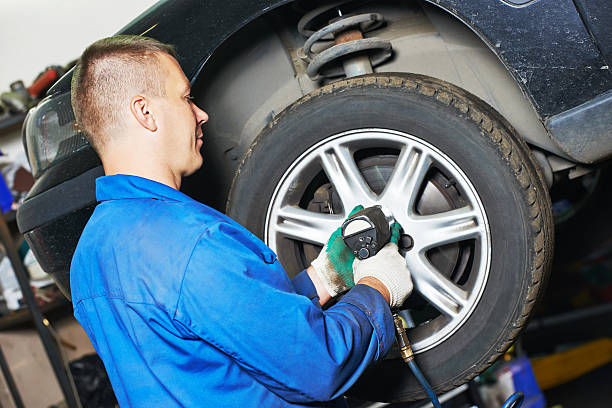
When it's determined that replacement is necessary, the car is safely raised, and the wheels are removed to access the braking assembly. The technician, taking care not to harm any other parts, will remove the worn brake pads. At this point, the condition of the clips, guide pins, anti-rattle springs, and mounting hardware is also assessed. The smaller parts assist with the correct function of the brakes, and if excessive wear or corrosion is detected, these components should be cleaned or replaced. Assistive derotation of the old pads can also enable the technician to examine for wear patterns, including the possibility of sticking callipers, uneven pressures, or alignment problems in the braking system.
Cleaning the Assembly
The professional replacement procedure involves cleaning. After some time has passed, dust, dirt, moisture, and even rust can accumulate around the braking system, which may affect the operation of the callipers and the braking system if not addressed.
Technicians normally clean:
Brake calliper brackets and brake calliper mounting surfaces.
Check for contact between pads that are moving.
Inspect and lubricate guide pins.
Proximity to areas where brake dust has collected.
A clean braking assembly will allow the new pads to glide without restriction, minimising brake assembly noise and uneven wear under normal driving conditions.
Installing New Pads
The new brake pads are then installed according to the manufacturer's specifications. The reason is that if the brake pads are not installed correctly, they might cause vibrations and even wear out prematurely. Brake Pad Replacement Coventry ensures that all the parts have been fitted properly before reassembly. They also ensure that the brakes exert an even pressure and that the pistons in the brake callipers retract effortlessly.
Checking Brake Discs
Brake pads and brake discs are part of the brake surface. The new pads can reduce braking effectiveness, and the life of the new pads can be shortened if they are installed against severely worn or damaged discs. Technicians look for a variety of problems in the discs before finishing.
Thinning beyond the manufacturer's specifications.
Extremely worn pads with grooves.
Excessive heat causing surface cracks.
Steering vibration at braking time due to warping.
When any of these conditions are found, additional repairs may be recommended before returning the braking system to service.
Final Testing Process
After all parts are back together, the braking system undergoes a series of final tests before the car is drivable. The following are typical checks:
Checking correct brake pedal pressure.
Smooth operation of callipers.
Checking all mounting bolts to torque.
Checking for leaks and abnormal body movement.
Conducting a controlled road test as appropriate.
The road test provides the opportunity for the technician to verify the brakes function continuously, are quiet, and can be controlled predictably during standard driving conditions.
Conclusion
Installation of new brake pads requires a sequence of actions to provide safety and precision and, at the same time, make braking effective and long-lasting. The entire process from inspection to removal, cleaning, installation, and testing enables the braking safety and efficiency to be restored and also the detection of any other possible defects that might endanger safety. While doing the inspection of the brakes, instead of just inspecting the brake pads, the technicians examine the whole braking system. This is done in order to make sure everything is functioning normally.


Thanks for sharing this informative article. I was interested in information about winpkr login, and the explanation made the topic easier to understand. Guides like this can help readers learn about account access and common requirements. It is also important to protect login details and use secure, trustworthy sources when accessing any online account.
Thanks for sharing this. I was searching for a reliable pinterest video download method, and this really helped me understand the options.